Why we are writing this blog
Most of the time, we use our platform to share practical technology insights, help organizations build stronger digital foundations, and offer guidance that supports the communities we serve.
But this week, something happened that made us step back and reflect on a much deeper issue:
ethics in the technology sector — or, in this case, the lack of it.
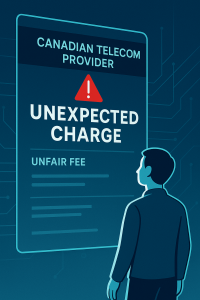
We received an email from a major telecommunications provider informing us that a retroactive fee would be added to our account — even though the associated lines had been cancelled long ago. The communication included:
- an insistence on taking an “urgent” call,
- vague implications of “further impact”,
- and a tone designed to generate pressure instead of clarity.
This was not a misunderstanding.
It was not a clerical error.
It was not standard practice communicated poorly.
It was a sales tactic built on fear, ambiguity, and the threat of financial consequence.
And while the charge itself affects us as a company, the incident reflects something bigger — something systemic.
If a technology-focused organization like ours can be subjected to this kind of pressure,
what happens to nonprofits, community organizations, and small entities with fewer resources and less technical support?
This is why we are writing this blog.
Because when basic ethical principles are compromised, it is no longer a question of billing.
It becomes a question of values.
It becomes a question of integrity.
It becomes a question of whether the industry is aligned with the missions of the organizations it claims to serve.
The Human IT Company is — unapologetically — a mission-driven organization. And when something contradicts our values, we do not ignore it.
A David and Goliath moment in the tech world
W hat happened this week felt like a modern, technological retelling of David and Goliath.
On one side: a massive corporation, backed by scale, influence, complex contracts, and the power to dictate terms. On the other: a small, purpose-driven company that chooses to lead with ethics rather than power.
And just like in the ancient story, the imbalance was not about size —it was about values.
Goliath relied on intimidation.
David relied on integrity.
The incident we experienced revealed something important about the tech sector: When size is used as leverage instead of responsibility, the ones who suffer most are the small organizations who depend on fairness to operate.
And that is precisely why mission-driven organizations exist — not to win through force, but through principle.
When technology providers use fear, trust breaks
Technology should empower organizations. All too often, the ecosystem surrounding it does the opposite.
Large providers hold enormous influence over pricing, contracts, and access to essential services. With that influence comes responsibility — yet many models within the industry prioritize:
- maximizing contract value,
- extracting fees wherever possible,
- relying on complex clauses for revenue,
- encouraging urgency where none exists,
- and leveraging confusion to maintain advantage.
None of this serves the customer.
And it certainly does not serve nonprofits or community-driven organizations whose missions depend on clarity, fairness, and predictability.
When providers use fear as leverage,
they are not selling a service — they are eroding trust.
Why this matters for mission-driven organizations
For The Human IT Company, this incident is more than an inconvenience.
It's a reminder of why our mission exists in the first place.
Being mission-driven is not about having a feel-good statement on a website.
It's about holding a standard that guides every decision we make, especially when it is inconvenient.
Our role is not simply to deliver technology services.
It's to demonstrate that ethical, transparent, value-aligned technology work is possible — and necessary.
What truly sets us apart
While some providers rely on pressure, opacity, or ambiguous practices, our standard is different:

Integrity is non-negotiable
If something is unclear, we clarify it.
If something is wrong, we say so.
If we make the mistake, we own it.
If something conflicts with our values, we do not participate — even if it costs us.
Transparency is a core operations principle, not a marketing angle
People deserve to understand what they are paying for. There is no fine print, no hidden structure, and no manufactured urgency. You ask, and we will answer you clearly and unambiguously.
Trust is not a tactical sales play
We do not use fear to win business.
We do not create pressure points to push decisions.
We do not believe in “sales at any cost.”
The purpose that guides our decisions
Every technical recommendation, workflow, and service design is filtered through one question:
Is this in our clients' GENUINE best interest? That is our Core Value #1, and we have it printed on the wall in our office.
We are a mission-driven organization — not because we say it, but because we act like it
This incident made one thing clear:
the world needs technology partners who lead with ethics, not profit. And we are proud to be one of them.
A message to the sector
We are not here to name or shame providers.
That is not our goal.
Our intention is to call attention to a systemic issue: When the technology industry normalizes ambiguity, pressure tactics, retroactive fees, and fear-based selling, it harms the very organizations that rely on it the most.
The path forward requires something simple but rare:
Technology must be ethical.
Mission must matter more than revenue.
Closing
Organizations — especially small organizations and nonprofits — deserve better than fear-based tactics, unclear billing, or avoidable pressure.
At The Human IT Company, we will continue to hold ourselves to the standard that the sector deserves:
Technology with purpose.
Technology with integrity.
Technology that aligns with the missions of those who serve our communities.
Because if we compromise on ethics, we compromise on everything.