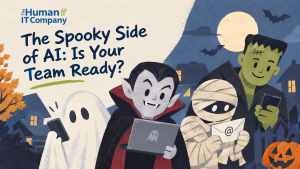
Take a walk through any neighborhood this Halloween and you’ll spot plenty of monsters. Vampires, ghouls, a suspiciously large number of ghosts made from bedsheets. They’re loud, they’re sugar-fueled, and they’re completely harmless.
The monsters worth knowing about in the business world are a lot quieter. They don’t announce themselves, not even as a joke. They just show up looking friendly and helpful.
Here’s the interesting part. Plenty of organizations like yours are using AI to boost productivity and strengthen security, and scammers have noticed the same tools can make their messages look more polished. That’s not a reason to panic. It just means a few of our old habits need a small refresh.
The good news is that you don’t need to become an expert scam-spotter. A handful of simple, steady habits will help your team feel confident when something seems a little off. Garlic is optional. Good processes do the real work.
AI Shapeshifters: Sounding Right Isn’t Enough Anymore
Not long ago, a voice message or a video call was a pretty reliable sign that you were talking to a real person. These days, AI can produce very convincing voices and video, which means a familiar face or voice doesn’t always tell the whole story.
You may think you could spot the giveaways, but those flaws are fading quickly, and a lot of the “AI tells” people rely on are already out of date. That’s okay! It just means we shouldn’t ask every employee to be a human lie detector.
A friendlier approach is to build verification into the process. For anything involving money transfers, account changes or sensitive information, add a quick check that doesn’t depend on a good impression. A shapeshifter can fool your eyes and ears, but it can’t fake multi-factor authentication or a solid verification routine.
AI Mummies: Same Old Tricks, Fresh New Wrappings
Phishing emails used to give themselves away. Typos, generic greetings and “ACT NOW!” urgency were all handy red flags, and plenty of teams were trained to look for them.
Those same messages have had a bit of a makeover. With clean spelling, grammar and punctuation, they sound more professional, and that polish can make them feel more trustworthy than they deserve.
Think of a mummy in fresh bandages: same old trick, new look. So shift the focus. Instead of hunting for mistakes in the writing, take a look at the request itself. Does it make sense? Is it something this person would normally ask? A well-written email isn’t automatically a trustworthy one, and a quick pause goes a long way.
AI Vampires: Never Invite Them In
In vampire lore, you’re safe as long as you never invite the vampire inside. AI tools work a little like that. When people use tools the company hasn’t approved (often called Shadow IT), it’s easy to share sensitive information without meaning to.
An AI tool can’t slip into your inbox and read everything. But it also won’t stop you from pasting in a quarterly report full of financial details and asking for a quick summary. Most of us have been tempted, because it’s genuinely convenient.
A good rule of thumb: if you can’t say where the information goes, how it’s stored, or what the tool’s creator can do with it, that tool hasn’t earned an invitation yet.
The Best Defense? Simple Habits and the Right People Beside You
AI has made convincing messages easier to create, but the fix doesn’t need to be complicated. When your team has a few small habits, like verifying sensitive requests, pausing before clicking and checking tools before using them, even the best disguise won’t throw them off.
It also helps to have people in your corner who understand that your team has a mission to focus on. A good IT partner starts with what you’re trying to get done rather than what’s broken, and keeps things simple enough that everyone on the team can follow along.
So enjoy the candy, admire the costumes, and rest easy knowing that a few good habits go a long way.